
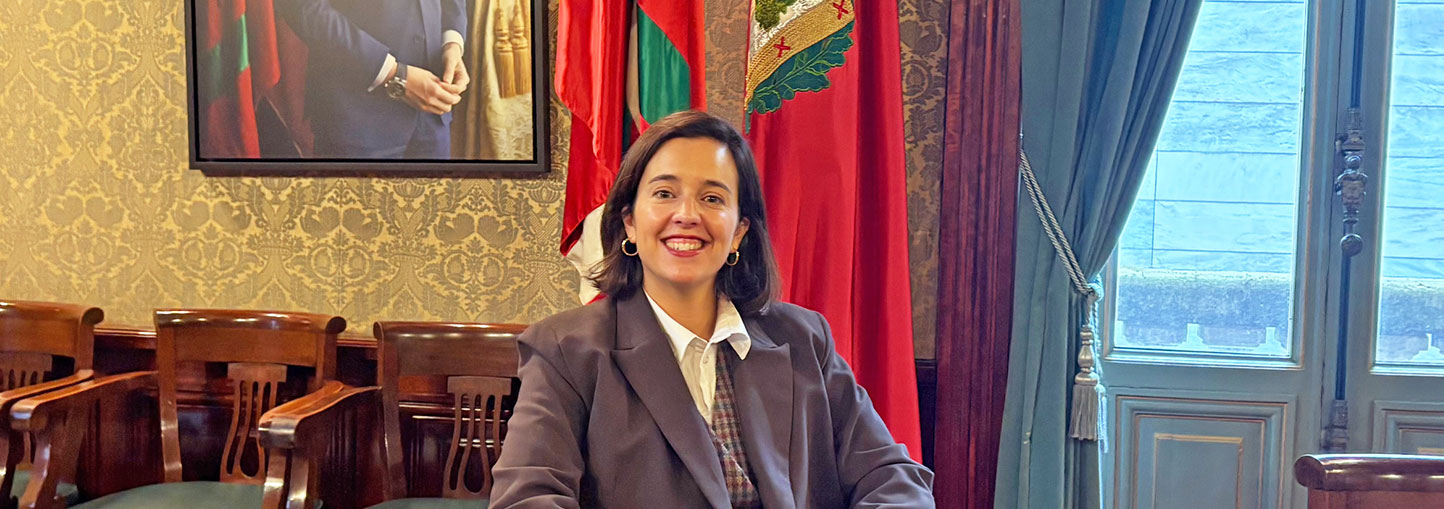
ITXASO BERROJALBIZ
Provincial Councillor for Finance and Taxation in Bizkaia
Itxaso Berrojalbiz, Provincial Councillor for Finance and Taxation in Bizkaia since 2023, is well acquainted with the different areas of Basque administration, having previously served as a councillor on the Amorebieta Etxano Town Council between 2015 and 2023 and a member of the Basque Parliament and spokesperson for Economy, Finance and Budgets between 2020 and 2023.
She holds a degree in Economics from the University of the Basque Country, specialising in Tax Analysis, and a Master’s degree in Executive Business Law from the Garrigues Study Centre in collaboration with Harvard Law School. Until joining the Basque Parliament, her professional career between 2008 and 2020 was linked to the practice of tax law at the Garrigues law firm. She has been a lecturer in the Master’s Degree in Tax Consultancy at the University of the Basque Country and the University of Deusto, and a regular speaker at seminars on tax practice held at financial institutions, insurance companies, etc.
He has also written articles for specialist tax journals.
Based on your professional experience, both in the private sector and in different areas of the public sector, how is the Economic Agreement perceived in each of these sectors and areas? How does the Economic Agreement affect or what role does it play in each of them? Are there any differences?
The truth is that, from the different areas, both public and private, in which I have had contact with the Economic Agreement, I have been, and continue to be, a privileged witness to the different ways in which this instrument, which is so important for our country, is experienced and perceived.
Starting with the professional side, in the firm where I have worked, in the environment of the Big Four or large firms, I believe that we focus on the analysis of regional regulations or amendments to the Economic Agreement as a purely technical legislative matter, that is, we studied and dissected these regulations with a view to their practical application, how they would affect our clients, without realising or appreciating the relevance of the Economic Agreement, which is really the weapon or keystone of everything we have built and without which we could not implement the fiscal policy designed by the Provincial Treasury or, of course, any other.
From the public sector, and starting with the most municipalist part, with which I first came into contact with politics, the distance from the Economic Agreement is clear, and even at the municipal level, there is no very different assessment of the Agreement; its existence is taken for granted, and although people are aware that it is the source of the resources needed to meet public needs, there is no awareness of its significance.
In my experience, something similar happens in the Common Institutions and parliaments, where you experience it from a more national perspective.
It is from my current position as Provincial Deputy for Finance and Insurance in Bizkaia that you really see the impact and importance of a strong Economic Agreement, what it represents for our self-government, and where you appreciate what a powerful tool it is for designing our policies to boost the productive fabric, protect people, and address the other challenges we face.
Focusing on its current position, during this first half of the legislative term in the Provincial Council, there have been a series of milestones closely related to the Economic Agreement.
Firstly, the Economic Agreement has been amended to recognise the Historical Territories’ regulatory capacity in relation to income tax for non-residents without a permanent establishment and in relation to new tax figures such as the supplementary tax or the tax on interest margins and commissions.
What can you tell us about the negotiations for its agreement?
What do you think it means for Bizkaia and the Basque Country to exercise regulatory powers over these taxes?
Our main interest and ultimate goal, whenever a new tax is created or an existing one is modified, is to achieve the highest levels of self-government because, as I just mentioned, it is the instrument we have to design our own fiscal policies, adapted to our needs. This maximum self-government is achieved through agreement with full regulatory capacity.
It is clear that, due to various circumstances, we do not always achieve our goal and, sometimes, agreement is reached without recognition of regulatory capacity or with limited capacity.
Thus, we encounter problems such as excise duties or VAT, where we are unable to develop our fiscal policy, for example, in the energy transition. If we had regulatory capacity, we could design a set of measures linked to the energy transition with new fuels, hydrogen or all the new technologies that are emerging.
However, in this legislative term, in which I am a member of the Treasury Committee, and despite the difficulty of negotiating with other institutions that do not share our vision, we have held several economic concertation and economic commission meetings in which we have made significant progress in this regard, both in the concertation of new taxes and in other issues such as the visibility of regional treasuries and their presence in international taxation forums.
Regarding these taxes you mention, I think it was an intense December. These new taxes, for example, the supplementary tax or the bank tax on margins and commission interest, must be remembered that they were approved in Congress on 20 December, three days later, on 23 December, we agreed to them with full regulatory capacity in both, and four days later, at the General Assemblies of Bizkaia, we were including an amendment in voce to incorporate these taxes into our tax system.
And it has not only been these two new taxes but, for example, as you also mentioned, the tax on non-residents’ income. Thanks to these intense negotiations, we have achieved full regulatory capacity for all personal taxes. We had it for income tax, corporation tax and IRNR (non-resident income tax), but only for income generated through a permanent establishment; now we have also achieved it for income obtained without the mediation of a permanent establishment.
So, well, we are always moving forward with our ultimate goal, which, as I said at the beginning, is to have more self-government, more regulatory power, and for the institutions of the historic territories to have regulatory power to define, design and establish our fiscal policy, adapted to our needs.
The third question, which is somewhat related to what we were discussing regarding the implementation and agreement of the supplementary tax that Basque institutions have had to regulate in order to incorporate the 15% minimum taxation set by the European Union as a result of the work of the OECD under the Inclusive Framework of Pillar II, reflects the evident influence of supranational bodies on national treasuries and, in our case, on Basque treasuries.
What are the regulatory powers of the historical territories and what challenges do the Basque treasuries face in the application of taxes?
It is clear that we live in an increasingly globalised and digitalised world and that the dependence of some administrations on others is something that has been proven and is not questioned by anyone, so international collaboration is an indisputable requirement if we want to achieve the highest levels of efficiency, progressivity and equity in the application of tax systems.
The limitations, if we want to call them that, imposed on us by international organisations, basically the OECD and the European Union, respond to principles that, in my opinion, are widely shared: avoiding the erosion of tax bases or the artificial transfer of profits to low-tax jurisdictions, ensuring that large corporations that impose their market- licies pay the taxes they owe in the jurisdictions where the profits are generated, attention to substance, etc.
The point is that these principles cannot be implemented without international cooperation, both in the design of tax systems and in their application.
That is why I prefer to talk about voluntary self-restraint in our capacity rather than external impositions. The fact is that for such self-restraint to be truly voluntary, two requirements must be met: we must have the regulatory capacity to decide on its incorporation into our own tax system, and we must participate on an equal footing in the process of designing and approving the measures in the international tax forums where they are discussed and approved.
We have made significant progress on both requirements in these latest negotiations.
With regard to the Complementary Tax, as I have already said, the recognition of full regulatory capacity, although it obviously homogenises us and apparently limits our self-government, allows us, within the margin recognised for all states, to design and adapt our regional corporate tax to this global minimum tax, for example, with the transferability of the deduction in Article 65 for environmental investments, applicable tax credits, temporary application limits, depreciation freedoms, accelerated depreciation and others that provide the necessary flexibility to adapt the tax to the PILAR II policy.
With regard to the second requirement, participation, we have expanded the presence of the Basque tax authorities to all relevant international taxation forums: with regard to the European Union, to high-level groups, as well as to plenary meetings where issues analysed in groups D 4 (tax issues) and D 5 (code of conduct) groups, and with regard to the OECD, in the FHTP, Global Forum, FTA, as well as in the work of the Inclusive Framework (IF) on BEPS of the OECD and the G20 led by the Committee on Fiscal Affairs.
In short, in my opinion, we are in the same situation as any member state of the European Union in terms of limitations on tax policy. We willingly accept these limitations as we share their philosophy and objectives and have the necessary instruments to ensure that our voice is heard in international discussion forums.
Following on from the above, with regard to the application of taxes in international taxation, an agreement was reached in the Joint Committee of the Economic Agreement of 13 November 2024 to promote the visibility and presence of regional treasuries at the international level.
How would you explain to the public what this agreement means?
This is linked to the challenge that our treasuries face in terms of their presence and participation in these international forums where the measures that our institutions are called upon to adopt are being designed.
We have to be in the OECD, in the high-level groups of the EU, including ECOFIN, that is, where decisions are made, and we have to be at the forefront as the comprehensive treasury that we are, on an equal footing with the Tax Agency itself or any administration of any other state.
Therefore, to explain to ordinary citizens the relevance of this agreement, I believe we must tell them that it is a good way to visualise that, although we are not an independent country and we are not a state like Spain or France, from a tax point of view we are, and therefore, from a tax point of view, we are, even though we are not a country, we are independent, we sit at the table where the future of taxation is decided, together with representatives of the state agency and other national tax administrations.
I believe that, for Basque citizens, beyond the importance that each person may attach to the recognition of regulatory capacity in personal taxation and the prominence that presence in international forums entails, we must convey the pride that our institutions, our tax authorities, are recognised as just another tax authority on an equal footing, as I have already said, with those of any EU Member State.
For citizens, for society as a whole, the fact that the tax authorities have managed to be in the places where fiscal policy is decided, which now transcends the borders of member states, should be a source of pride.
Let’s change the subject a little. Now that there is so much talk about the artificial intelligence revolution that will transform the world, how will artificial intelligence affect the work of the regional tax authorities and their relations with citizens?
It is clear that AI is here to stay and that it will probably revolutionise the way we work sooner rather than later.
In any case, I believe that as a tax authority we must continue to focus on the personalised service that has always characterised us and that is so highly valued not only by citizens but also by businesses and social agents.
Therefore, my initial thought is that AI cannot and should not replace this personalised attention.
That does not mean that, as a modern administration, we do not have to move forward and use new technologies; of course we will. In fact, we are already using some pilot projects related to AI. We believe, for example, that could be a good tool for analysing and managing telephone support, seeing which incidents are repeated and, as a result, generating more efficient responses, adapted frequently asked questions, more automated response guides and AI helping us to respond en masse to what citizens generally demand. Another area is the detection of tax fraud, i.e. entering the digital world and analysing recurring elements and detecting information.
In short, AI yes, but to improve the efficiency and quality of service and without replacing the close and personalised attention that characterises our tax office, because if there is one thing that is positively valued about the services of our regional tax office (9 out of 10 in the latest survey), it is its proximity and the legal certainty that derives from its actions.
Let’s move on to talk about the recent tax review approved in Bizkaia through Provincial Regulation 2/2025 of 9 April, which has been carried out by consensus between the three provincial councils in order to respond to the challenges facing Basque society and Bizkaia in particular.
How do you balance obtaining the resources necessary to sustain public spending with the use of taxation to achieve economic, environmental or social promotion goals?
No one can fail to see that striking a balance between achieving fiscal policy objectives and ensuring sufficient funding to cover the cost of the welfare state services we have established for ourselves is not always an easy task. Furthermore, judgements about the suitability of the measures adopted are always influenced by individual ideology or opinion.
The fact is that, when defining and specifying our fiscal policy, we have to respond to the challenges facing society, while ensuring the fairness, progressiveness and equity of the system, as well as the financial sufficiency of all institutional levels operating in the Basque Country and financed by resources derived from the Economic Agreement. And this must be done taking into account the limitations in force in each tax category when designing and defining its content.
And that is what we have tried to do in the recently approved tax review. If we take a quick look at it, we can see how the main challenges that it was deemed appropriate to respond to have been identified, with a chapter of the Provincial Law devoted to each of them: family, equality, work-life balance, women and youth (Chapter I), housing (Chapter II), social welfare (Chapter III), green taxation (Chapter IV), and the fight against tax evasion (Chapter V). a chapter of the Provincial Law has been devoted to each of them: family, equality, work-life balance, women and youth (Chapter I), housing (Chapter II), social welfare (Chapter III), green taxation (Chapter IV), progressivity and redistribution of wealth (Chapter V) and protection and promotion of the productive fabric (Chapter VI).
With regard to financial sufficiency, it is true that the latest tax review will lead to a relative reduction in revenue. We are talking about an estimated reduction of 270 million at the regional level for the three territories, when we are collecting more than 20 billion.
Therefore, we do not believe that these figures compromise the financial sufficiency of our institutions in any way. Furthermore, we must weigh up the objectives we are pursuing at a time when we all agree that there are challenges we must address as a society, such as those addressed in the review and which I have just listed.
What we have to do is use fiscal policy as a catalyst, a driving force, an incentive, and we cannot incentivise, we cannot act as a catalyst, we cannot address these challenges without reducing the tax burden to some extent.
I often say that our fiscal policy should be more about carrots than sticks, that is, to encourage people to choose the path of equality, work-life balance, and energy transition, to address the housing challenge so that there is more housing supply, so that supply and demand are balanced, so that in the energy transition, industries make decarbonised investments so that they can then be competitive and, as I said, always keeping financial sufficiency in mind.
Okay, and now what is being worked on at the fiscal policy level?
I think there is a feeling that the fiscal review is the end of the world, that we carry out a fiscal review every 8 or 10 years and then no further measures are taken. I think what the citizens of Bizkaia need to know is that fiscal policy is alive and well and that every year we draw up tax measures and, if a need is identified in our territory, we analyse it, regardless of whether or not there is a fiscal review or reform underway.
In fact, we are already working on the next tax measure, which in 2026 will address another of the challenges we face as a society: the establishment of our companies, attracting, retaining and keeping professionals in our territory, generational change, business succession, etc.
With the same objective I defined earlier: that companies invest here, that companies put down roots here, that they generate quality employment here and that people, therefore, live and have a future in Bizkaia.
We’re coming to the end. Finally, on the subject of taxation and finance, and given the time of year, what would you ask Olentzero for in relation to all these issues concerning taxation?
Well, I love asking Olentzero for things, even though sometimes he doesn’t bring me everything I ask for. That’s why I’m only going to ask for two things, both related to the Economic Agreement.
The first is that, sooner rather than later, we can strengthen our self-government by recognising our regulatory capacity in those taxes where we are currently more limited, such as VAT and excise duties. In relation to VAT, this would allow us, within the margins defined by the Directive, to adapt the regulation of the tax to the needs of our productive fabric. As for excise duties, as I said before, we could take many decisions on energy transition.
The second has to do with the work of the Ad Concordiam Association. I would ask Olentzero to ensure that its work is as successful as possible so that most Basque citizens are aware of the importance of the instrument we have at our disposal for their well-being, value it as I believe it deserves, and take an interest in learning a little more about it because, as a negotiator of the Economic Agreement said, “what is not known is not loved”. Especially now that we will soon be celebrating its 150th anniversary in 2028.
Eskerrik asko.
Eskerrik asko zuei.
